
Yes—therapy can be tax-deductible in California when it qualifies as medical care, you paid the expense without reimbursement, and you itemize deductions. For 2026, the federal medical-expense deduction generally covers only qualifying expenses above 7.5% of adjusted gross income, not your entire therapy bill. California also allows an itemized medical-expense deduction, but state adjustments can change the calculation; a deduction reduces taxable income rather than refunding what you paid.
TL;DR
Is therapy tax deductible in California? Yes, when treatment qualifies and you meet medical-expense deduction rules.
The federal deduction covers qualifying medical expenses above 7.5% of adjusted gross income when you itemize.
California permits a medical-expense deduction, but your state calculation can differ from your federal return.
Awaken Therapy provides integrative psychotherapy for teens, adults, and high-masking autistic women in California.
Why this matters
Paying for therapy and receiving a tax benefit are separate questions. You can receive qualifying treatment and still have no medical deduction because your expenses do not exceed the income threshold or itemizing does not benefit you.
Awaken Therapy serves teens, adults, and high-masking autistic women seeking integrative psychotherapy in California. You can learn about Awaken Therapy while keeping the clinical decision separate from the tax decision. Whether support fits your needs is not determined by whether a tax return recognizes the expense.
Is therapy tax-deductible in California?
Therapy can qualify for both federal and California medical-expense deductions when its primary purpose meets the applicable medical-care rules. The IRS explains those rules in Publication 502, Medical and Dental Expenses, and Tax Topic 502. California's Franchise Tax Board explains state itemized deductions in the Schedule CA instructions.
For your 2026 return, distinguish the following calculations rather than assuming that a federal result automatically carries over unchanged.
Federal medical-expense deduction
Best for: Eligible taxpayers who itemize federally
What it permits: Deducting qualifying, unreimbursed medical expenses above 7.5% of AGI
Main limitation: Only the amount above the threshold counts; the standard deduction can be more beneficial
California medical-expense deduction
Best for: Eligible taxpayers who itemize on their California return
What it permits: Deducting qualifying medical expenses under California rules
Main limitation: State adjustments and the California standard deduction require a separate calculation
Neither deduction makes every therapy session deductible. Start with the purpose of the care, then check payment, reimbursement, the income threshold, and itemization.
Which therapy expenses qualify as medical care?
The IRS medical-expense rules cover expenses primarily for the diagnosis, treatment, mitigation, or prevention of disease, along with other specified medical purposes. Psychiatric care and qualifying psychological treatment fall within those rules. A service described as therapy is not automatically eligible simply because someone finds it helpful.
For psychotherapy, the question is whether the service constitutes qualifying medical care rather than general personal development or support for overall well-being. Treatment addressing a mental health condition has a different tax basis from a workshop purchased solely for personal growth.
That distinction is administrative, not a judgment about what you need. Relationship support, stress management, and self-understanding can matter deeply even when an expense does not meet the tax definition of medical care.
Consider these distinctions:
Psychotherapy: Qualifying treatment can count as a medical expense when its purpose meets the medical-care rules.
General wellness support: Services solely intended to improve general health or well-being do not qualify on that basis alone.
Relationship counseling: The label alone does not establish eligibility; the medical purpose of the service matters.
Screening or assessment: A diagnostic medical service can qualify, but not every questionnaire, educational evaluation, or self-assessment is medical care.
You do not need to diagnose yourself to ask about documentation. Ask the provider what service was delivered and ask a tax professional how the expense should be treated.
Federal deductions: the 7.5% AGI threshold
For federal medical deductions in 2026, only qualifying medical expenses above 7.5% of your adjusted gross income are potentially deductible. AGI is a tax-return figure, not simply your salary, take-home pay, or household budget.
The calculation uses your eligible medical expenses together. Therapy is not tested against the threshold in isolation. Other qualifying, unreimbursed expenses can contribute to the same total, including eligible medical visits, prescriptions, and dental care.
The calculation follows this order:
Gather eligible expenses. Identify qualifying medical payments made during the tax year.
Remove reimbursements. Exclude amounts paid back by insurance or otherwise covered without an eligible personal expense.
Apply the threshold. Subtract 7.5% of AGI from the qualifying total.
Compare deductions. Assess whether itemizing is more beneficial than taking the standard deduction.
Crossing the medical threshold does not, by itself, establish that itemizing is your better choice. Medical expenses are one part of the itemized-deduction calculation.
This is also why the deductible amount can be much smaller than your annual therapy spending. The threshold excludes part of your qualifying expenses before the itemization comparison even begins.
California deductions: calculate the state return separately
California generally permits an itemized medical-expense deduction using a 7.5% AGI threshold, with state adjustments where applicable. The Franchise Tax Board's Schedule CA instructions govern the California calculation.
You can itemize on a California return even if you take the standard deduction on your federal return. That distinction matters because federal and California deduction amounts and adjustments are not identical.
For 2026 planning, avoid stopping at the federal answer. A federal return showing no benefit from itemizing does not establish that California itemizing has no benefit. Equally, a federal medical deduction does not guarantee an identical state deduction.
Ask your preparer to compare the California standard deduction with your allowable California itemized deductions. Keep the supporting therapy records available for both calculations, rather than treating the state return as an automatic copy of the federal one.
Reimbursements and tax-advantaged payments change the answer
The same therapy expense cannot receive a second tax benefit through a medical deduction. Amounts reimbursed by insurance are not unreimbursed medical expenses. Expenses covered by tax-free health savings account or flexible spending account distributions also cannot be deducted again.
If you paid the provider and later received partial insurance reimbursement, the unreimbursed portion is the starting point for evaluating a deduction. The provider's original invoice alone does not show your final eligible amount.
Keep a record of who paid and how:
A personal payment needs to be matched with any later insurance reimbursement.
A tax-free HSA distribution needs to be kept separate from expenses considered for an itemized deduction.
A tax-free FSA reimbursement cannot also support a medical-expense deduction.
A reimbursement received in a later tax year needs separate attention, especially if the original expense produced a deduction.
The IRS addresses later reimbursements in Publication 502. Tell your preparer when payment and reimbursement occurred in different years; do not simply reuse an older expense total.
Why your therapy deduction varies
A deduction depends on your tax circumstances as well as the care itself. These factors explain why people paying for similar services can receive different tax results:
Medical purpose: The service must meet the medical-expense rules. A provider's use of the word therapy does not replace that requirement.
Total qualifying expenses: Eligible medical spending beyond psychotherapy contributes to the calculation. Looking only at therapy can leave out relevant expenses.
Adjusted gross income: The 7.5% threshold changes with AGI. The same expense total does not produce the same deductible amount for every taxpayer.
Reimbursement and payment source: Insurance payments and tax-free account reimbursements reduce the expenses available for a deduction.
Itemization: A qualifying expense does not automatically make itemizing preferable to the standard deduction.
Payment timing and state adjustments: The year you paid generally controls the deduction year, while California adjustments can change the state calculation.
You do not need to resolve each factor before seeking care. The practical step is to preserve accurate records so you can evaluate the tax treatment without reconstructing everything later.
What records should you keep for therapy expenses?
Keep enough information to connect the service, payment, and reimbursement. A calendar showing that you attended therapy is not the same as a record establishing an eligible medical payment.
Use this sequence to organize your 2026 records:
Gather receipts. Save statements identifying the provider, service date, service description, and amount charged.
Match payments. Keep evidence of what you actually paid and when. A bill marked as outstanding does not establish payment.
Check reimbursements. Match insurance explanations of benefits and other reimbursement records to the relevant charges.
Separate account payments. Identify expenses paid through an HSA or reimbursed through an FSA so they are not deducted again.
Review tax treatment. Give your preparer the reconciled records, along with any questions about whether a service qualifies.
These steps are an organizational guide, not a substitute for the documentation requirements that apply to your return. Ask for clarification when a statement does not identify the service clearly.
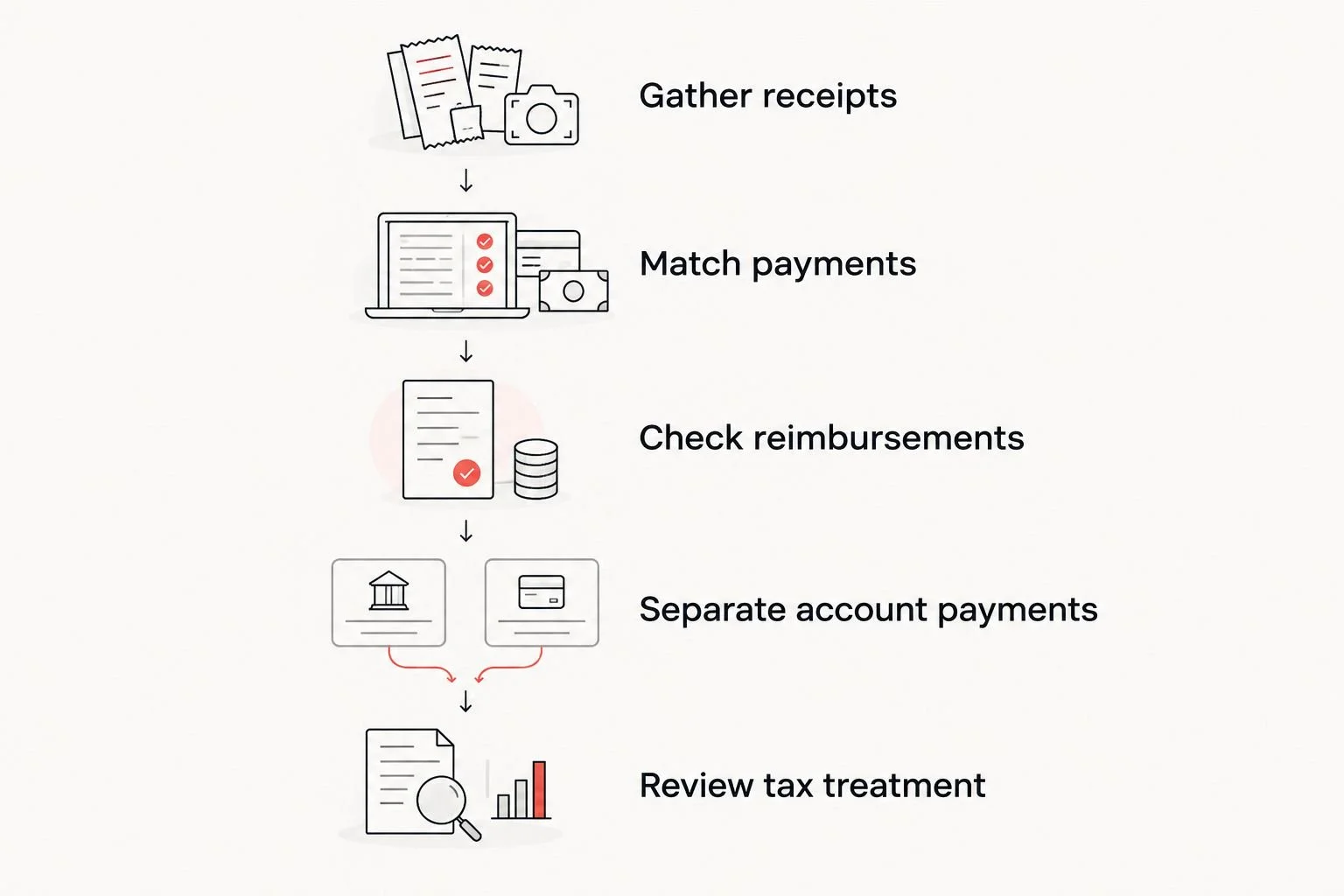
Match each therapy payment with its reimbursement record before evaluating a deduction.
Protect your privacy while organizing records. You do not need to send psychotherapy session notes with a routine tax return. If additional substantiation is requested, ask what documentation is necessary before sharing sensitive clinical information.
Can I deduct therapy if I take the standard deduction?
The 7.5% AGI threshold does not create a separate deduction outside itemization. On your federal return, choosing the standard deduction means you do not also claim an itemized medical-expense deduction.
California requires a separate comparison. You can take the federal standard deduction and still itemize on your California return when state itemization is appropriate.
Do not confuse an itemized deduction with HSA or FSA eligibility. Those accounts have their own eligibility and reimbursement rules; they are not an additional itemized deduction for the same payment.
Can I deduct therapy without a formal diagnosis?
A formal diagnosis is not the only issue that determines deductibility. The expense must meet the medical-care definition, and your records must substantiate the expense. An invoice labeled counseling, on its own, does not settle the question.
Do not pursue or request a diagnosis solely to obtain a tax deduction. If you are exploring ADHD, autism, masking, or overwhelm, keep the clinical question focused on understanding your experience and support needs. Ask the provider about accurate service documentation rather than asking for a tax-driven clinical label.
Does online therapy qualify for a deduction?
Online delivery does not by itself disqualify psychotherapy from being a medical expense. The same questions apply: whether the care qualifies, what you paid, whether you were reimbursed, and whether you meet the deduction rules.
For California treatment, professional licensing and permission to provide care are separate questions from deductibility. A service being offered online is not proof of either appropriate clinical authorization or tax eligibility.
Keep the same payment and service records you would retain for in-person care. A payment confirmation that identifies only a platform does not necessarily explain what service you received.
Where should you check the rules for 2026?
Use IRS Publication 502 and Tax Topic 502 for federal medical-expense rules. For California, use the Franchise Tax Board's Schedule CA instructions and its guidance on itemized deductions. Read the instructions applicable to the return you are preparing, rather than relying on a search snippet without a tax-year context.
A therapist can describe the care provided and supply available billing documentation. A tax professional determines how the rules apply to your return. Keeping those roles separate protects both accurate reporting and the clinical purpose of treatment.
This article provides general tax information, not individualized tax or legal advice. Ask a qualified tax professional about your filing status, reimbursements, dependent expenses, and California adjustments.
FAQ
Is therapy tax deductible in California in 2026?
Yes, qualifying psychotherapy can be deductible in California when you meet the medical-expense and itemization rules. Evaluate your federal and California returns separately, and exclude reimbursed expenses.
Can I deduct all the money I spend on therapy?
No. The federal medical deduction generally covers only qualifying, unreimbursed medical expenses above 7.5% of adjusted gross income, and you must itemize.
Can I deduct therapy that my insurance reimbursed?
No, you cannot deduct the portion reimbursed by insurance. An unreimbursed portion can enter the medical-expense calculation if the service qualifies.
Can I deduct therapy paid for with my HSA?
You cannot claim an itemized deduction for an expense covered by a tax-free HSA distribution. The same expense cannot receive both tax benefits.
Does couples therapy count as a medical expense?
Couples therapy does not automatically qualify as a medical expense. The service's medical purpose matters; general relationship support alone does not establish deductibility.
Can I itemize in California if I take the federal standard deduction?
Yes, California allows you to itemize on your state return even if you take the federal standard deduction. Compare your allowable California itemized deductions with the California standard deduction.
Can autism screening or an ADHD assessment be deductible?
A diagnostic assessment can qualify when it meets the medical-care rules. Educational testing, informal screening tools, and self-assessments do not automatically qualify simply because they concern autism or ADHD.
Can Awaken Therapy tell me whether my sessions are deductible?
Awaken Therapy is a psychotherapy practice, not a source of individualized tax advice. Ask a tax professional to evaluate the service documentation, payments, reimbursements, and rules that apply to your return.
One last thing
Build a medical-expense record, not just a therapy-expense record. The threshold applies to your combined qualifying expenses, so reviewing psychotherapy in isolation can give you an incomplete answer.
For 2026, keep one organized set of service statements, payment records, and reimbursement documents. You can then assess the tax question without turning your therapy sessions into a discussion about proving your needs. Whether a deduction is available does not determine whether your experience deserves care.