
Yes, autism is underdiagnosed in adult women, including women whose social adaptations make their support needs less visible. Masking, stereotypes about autism, and overlapping mental health conditions can contribute to missed recognition; none of these experiences alone establishes a diagnosis. This 2026 guide explains what can be overlooked and how to seek support without deciding your diagnosis in advance.
TL;DR
Is autism underdiagnosed in adult women? Yes; masking and recognition gaps can contribute to missed identification.
Autism screening identifies questions for further assessment; it does not establish a diagnosis.
Awaken Therapy offers psychotherapy support for high-masking autistic women in California.
A thoughtful adult autism assessment considers developmental history, current needs, and other possible explanations.
Why this matters
You can appear capable while working hard to manage conversation, sensory input, or unexpected changes. When other people see only the finished task, they can miss the effort and recovery behind it. That gap deserves attention, whether or not an autism assessment ultimately explains your experience.
Awaken Therapy offers integrative psychotherapy and autism screening, including support for high-masking autistic women. Screening and therapy serve different purposes from a diagnostic assessment, so clarify what you want from an appointment before choosing a service.
In 2026, greater public discussion of autism does not replace an individual assessment. You deserve room to explore a possibility without being dismissed—and without being pushed toward a label.
Is autism underdiagnosed in adult women?
Yes. Autism can go unrecognized in adult women, particularly when their outward presentation does not match familiar stereotypes. Some women reach adulthood with explanations for individual difficulties but without an assessment that considers their developmental pattern as a whole.
The NHS guidance Signs of autism in adults specifically describes differences in how autism can appear in women, including hiding signs to fit in. NICE's Autism spectrum disorder in adults: diagnosis and management recommends considering developmental history, functioning, sensory differences, and coexisting conditions during assessment. These are clinical reference points for this 2026 overview, not a checklist for diagnosing yourself.
You participate in conversations
What an assessment should explore: Whether you rehearse, copy others, or need substantial recovery afterward
What it cannot establish alone: Social participation does not rule autism in or out
You have friendships or a partner
What an assessment should explore: How relationships develop and what effort or difficulties they involve
What it cannot establish alone: Having relationships does not exclude autism
You do well academically or at work
What an assessment should explore: Whether structure, preparation, or private recovery makes that possible
What it cannot establish alone: Achievement does not measure support needs
You have an anxiety or ADHD diagnosis
What an assessment should explore: Whether it explains your experiences fully or exists alongside another condition
What it cannot establish alone: Another diagnosis does not confirm or exclude autism
These examples describe questions worth exploring, not hidden proof of autism. An assessment needs to consider alternative explanations rather than treating every familiar experience as confirmation.
How masking can make autism harder to recognize
Masking, sometimes called camouflaging, describes efforts to conceal differences or manage how others perceive you. Examples include rehearsing conversations, copying facial expressions, forcing eye contact, or suppressing movements that help you regulate.
Some of these strategies are deliberate. Others become so familiar that you notice them only when you are exhausted or have privacy. Masking is not exclusive to women, and not every autistic woman masks.
The clinically useful question is not simply whether you can perform a social task. It is also how you do it, how flexible that ability is across situations, and what it takes out of you. Appearing comfortable during an appointment does not settle those questions.
You might find it easier to describe a specific event than to summarize yourself. For example, explain what you prepared before a meeting, what you monitored during it, and what you needed afterward. That gives a clinician more context than saying you are either good or bad at socializing.
Visible competence and unmet support needs can coexist. Neither should cancel out the other during a careful assessment.
Why recognition varies between women
There is no single presentation of autism in women. Recognition depends partly on a person's experiences and partly on what the people around them know to look for.
Social adaptation: Rehearsed responses or copied social behavior can make differences less apparent during a brief encounter.
Stereotypes: Expectations that autism always involves obvious social withdrawal can obscure a more varied presentation.
Overlapping conditions: Anxiety, depression, ADHD, and trauma-related difficulties can complicate interpretation. These conditions can also coexist with autism.
Available history: Childhood records and family recollections vary in detail. Quiet distress or private coping strategies might never have been documented.
Environmental demands: A structured setting can support functioning, while transitions or competing demands can reveal difficulties that were less visible before.
None of these factors establishes why a particular person was missed. They explain why a clinician should look beyond a brief impression and ask about patterns across settings and over time.
Does having anxiety or ADHD mean autism was missed?
An anxiety or ADHD diagnosis does not automatically mean autism was overlooked. It can be accurate, incomplete, or part of a more complex picture; sorting that out requires assessment rather than replacing one label with another.
ADHD and autism are distinct neurodevelopmental conditions that can occur together. Difficulties with attention, transitions, regulation, or social situations need context because similar outward experiences can have different underlying explanations.
For example, avoiding a gathering might relate to sensory overload, fear of judgment, difficulty following conversation, trauma reminders, or several factors at once. The behavior alone cannot identify the cause. What happens before, during, and after it matters.
If previous treatment helped with anxiety but left other difficulties unexplained, bring that history to an appointment. Partial benefit does not prove autism, and ongoing difficulty does not mean you failed treatment. Both are useful information about what still needs attention.
Is an autism screening the same as a diagnosis?
Autism screening is not a diagnosis. It can help organize questions and identify whether a fuller assessment deserves consideration, but a questionnaire score cannot establish your developmental history or explain every overlapping condition.
Different routes address different needs. Before booking, ask what the service includes, what conclusions it can provide, and whether it produces the documentation you need.
Autism screening
Best for: Exploring whether further assessment makes sense
What it can offer: A structured starting point for discussion
Important limitation: Does not establish a diagnosis
Diagnostic assessment
Best for: Seeking diagnostic clarification
What it can offer: Evaluation of developmental history, current presentation, and other explanations
Important limitation: Scope and documentation need clarification before booking
Psychotherapy
Best for: Addressing distress, coping, relationships, or identity
What it can offer: Space to explore experiences and practical support needs
Important limitation: Therapy alone is not necessarily a diagnostic assessment
Awaken Therapy offers psychotherapy and autism screening. Awaken Therapy is an option for high-masking autistic women seeking psychotherapy in California. If your goal is a formal diagnosis or documentation for a particular purpose, ask whether the service you are considering meets that goal rather than assuming screening will be sufficient.
How can you prepare for an adult autism assessment?
You do not need to present a polished case or prove that you fit a stereotype. Preparation is most useful when it helps you describe your experience accurately, including details that do not fit your current explanation.
Describe current experiences
Write down concrete situations involving communication, sensory input, routines, change, interests, or recovery after social demands. Include what other people see and what they do not see. A short example is often more useful than a long list of traits copied from the internet.
Gather developmental context
Consider what you remember about childhood friendships, play, school, transitions, and sensory experiences. School reports or someone who knew you early in life can add context when available. Ask the assessor how they work with incomplete records or unavailable family members.
Include other explanations
Bring relevant mental health history, previous assessments, and information about what has or has not helped. Include experiences that seem inconsistent with autism, too. A careful assessment examines competing and coexisting explanations rather than collecting only confirming details.
State your goals
Explain whether you want diagnostic clarification, a better understanding of your needs, support with distress, or documentation for a specific purpose. These goals overlap, but they are not interchangeable. Naming them helps you ask whether an appointment is the right fit.
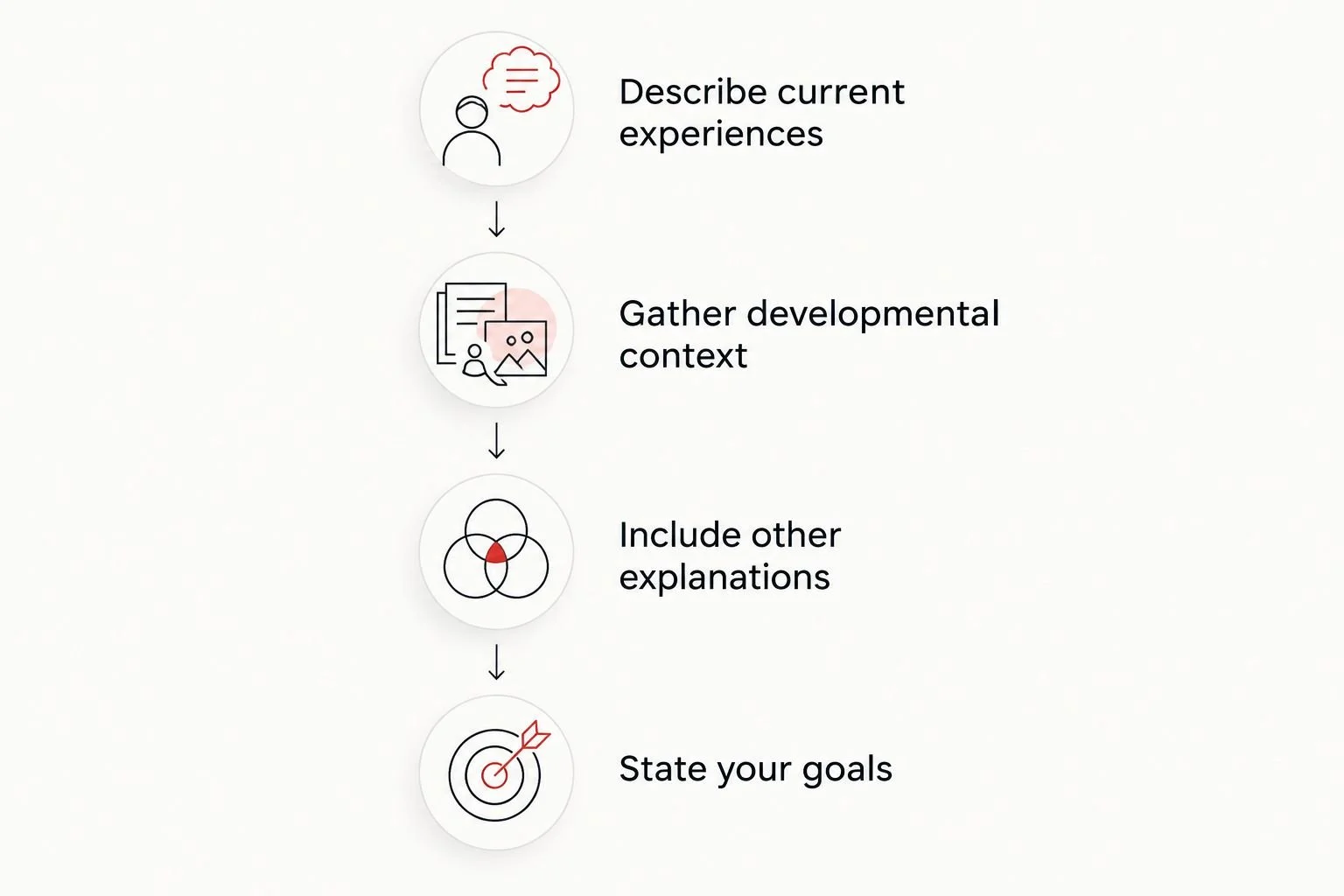
Preparation should make your experience easier to describe, not turn it into a case you must prove.
What should you ask before choosing a clinician?
For a 2026 appointment, ask directly about experience assessing adults whose differences are less visible. An autism service label alone does not tell you how a clinician approaches masking, overlapping conditions, or gaps in childhood information.
Useful questions include:
How do you explore masking without assuming that every social adaptation indicates autism?
How do you distinguish autism from other explanations while considering conditions that can coexist?
What developmental information do you request, and what happens if it is unavailable?
Is this appointment screening, psychotherapy, or a diagnostic assessment?
What feedback and documentation does the service include?
Notice whether the answers leave room for uncertainty and your own account. A clinician should be able to explain the process without promising a particular conclusion. You can also ask about written notes, breaks, or other communication preferences before the appointment.
Can you seek support before you have a diagnosis?
Yes. You can seek help for sensory distress, overwhelm, relationship strain, or exhaustion without first settling whether you are autistic. The immediate goal can be understanding what is difficult and what support is appropriate.
Start with the problem rather than an identity you feel obliged to defend. You might want help noticing overload earlier, communicating a boundary, or understanding why certain interactions leave you depleted. Those concerns are valid subjects for therapy in their own right.
Support should preserve your agency. You do not have to disclose a possible diagnosis widely, stop every coping strategy, or make sudden changes to how you socialize. Explore what feels useful and safe with a clinician who takes both your distress and your uncertainty seriously.
FAQ
Can I be autistic if I have friends and make eye contact?
Yes. Having friends or making eye contact does not exclude autism, but neither confirms it. An assessment considers your broader developmental pattern and how you experience social interaction.
Does a high autism screening score mean I am autistic?
No. A high autism screening score is not a diagnosis. It provides information to discuss alongside developmental history, current experiences, and other possible explanations.
Can ADHD and autism occur together in adult women?
Yes. ADHD and autism can occur together in adult women. Assessment should consider both conditions without assuming that one diagnosis explains every difficulty.
Is masking something only autistic women do?
No. Masking is not exclusive to autistic women, and not every autistic woman masks. Its meaning depends on the wider pattern of experiences being assessed.
What if nobody noticed signs when I was a child?
A lack of childhood recognition does not by itself rule out autism. An assessor can explore developmental history and discuss the limits of missing records or incomplete recollections.
Should I stop masking before an autism assessment?
You do not need to force yourself to stop masking before an assessment. Describe the strategies you use and their impact, and ask how the clinician explores differences that are not obvious during an appointment.
Can therapy help me explore autism without a diagnosis?
Therapy can provide space to explore experiences, identity, and support needs without deciding a diagnosis in advance. Clarify whether the clinician also offers screening or diagnostic assessment, because these are different services.
One last thing
Before your next appointment in 2026, write down what happens after an activity you appear to manage well. Describe the recovery you need, the sensations you notice, and what becomes harder afterward. That information can make otherwise invisible difficulties easier to discuss.
You do not have to prove that you are struggling by becoming visibly overwhelmed. Your account deserves careful attention, whether the eventual explanation is autism, another condition, several overlapping factors, or something that still needs exploration.