
CBT can help some autistic adults with specific mental health difficulties, but it should not turn accurate experiences of rejection, discrimination, or sensory distress into thinking errors. Research documents both social bias against autistic people and limitations in how some autistic adults experience CBT. The question is not just whether symptoms improve, but whether therapy respects what has happened to you and helps change what is happening now.
TL;DR
Is CBT effective for autistic adults? Sometimes, but validation, practical adaptations, and meaningful goals matter.
Sasson and colleagues documented negative first impressions and reduced willingness to interact with autistic people.
Challenging a belief about rejection is not helpful when therapy ignores evidence that rejection has occurred.
Workplace adjustments and practical problem-solving should not be replaced by pressure to think more positively.
Short-term symptom improvement does not establish that ongoing exclusion or long-standing distress has been resolved.
Why this matters: Being told that your interpretation is the problem can be painful when you are already struggling to be believed. If you are seeking support through Awaken Therapy, the conversation can start with what you have experienced, not with a requirement to explain it away.
Is CBT effective for autistic adults?
CBT is a possible tool for an agreed difficulty, not a reason to distrust an autistic person's account of their life. It includes practical problem-solving, behavioral work, and examining thoughts; it does not have to mean disputing everything painful you believe.
The evidence supports a more careful answer than an unqualified yes. Linden and colleagues' review, published online in 2022, examined mental health interventions across autistic age groups and found substantial uncertainty. Its adult anxiety analysis included 13 trials with 526 participants, covering several interventions—not CBT alone. Those findings should not be read as proof that one approach reliably works for every autistic adult.
A separate review by Schweizer and colleagues, published in 2024, found promising preliminary results for CBT-based approaches but called for stronger research and evaluation of long-term outcomes. Some benefits persisted at follow-up; other outcomes did not improve.
These findings support access to treatment with realistic expectations. They do not justify insisting that CBT must work if you try hard enough, or treating disagreement with a technique as evidence of resistance.
What if “people don't like me” reflects real rejection?
A statement such as “people don't like me” needs context before it needs correction. It might describe repeated exclusion by particular colleagues, an expectation shaped by previous bullying, a broader conclusion about everyone, or several of these at once.
In their 2017 paper, Neurotypical Peers are Less Willing to Interact with Those with Autism based on Thin Slice Judgments, Sasson and colleagues reported findings across three studies. Non-autistic observers formed less favorable first impressions of autistic people and expressed less intention to interact with them. The pattern appeared quickly; it was absent when judgments were based on conversational content without audiovisual cues.
That is evidence that social bias is real. It is not evidence that every non-autistic person dislikes autistic people, or proof of what a particular coworker thinks. It does mean that a therapist should not assume that perceived rejection is imaginary simply because the client is anxious.
Recognizing rejection and questioning global self-blame are compatible. Therapy can acknowledge that particular people have excluded you while exploring whether their behavior means you are unlikeable, undeserving, or destined to be rejected everywhere. The second conversation should not erase the first.
What has research found can go wrong in CBT?
A qualitative study by Roisenberg and colleagues, published online in 2025, interviewed 27 autistic adults following a modified CBT group program for social anxiety. Participants described both benefits and difficulties. Peer connection, self-understanding, and structured strategies were helpful for many; sensory demands and applying strategies outside the group were challenging for some.
The authors also discussed how an expectation to think differently about social fears could be misaligned with histories of actual rejection. Some participants found strategies too narrow for long-standing emotional difficulties or complex real-life situations.
This was a study of one adapted program, not a measure of how often all CBT causes harm. Interviews took place during the final week, so they could not establish lasting benefit or lasting harm. Participants had completed the program, and only some agreed to interviews—another limit on generalizing their experiences.
Still, their accounts identify questions therapy needs to take seriously:
Is the technique responding to your circumstances or imposing an explanation?
Can you describe exclusion without being redirected immediately to your thinking?
Do exercises help outside the therapy room?
Can you question the method without being blamed for its limitations?
When can cognitive reframing feel like gaslighting?
Cognitive reframing means reconsidering how you understand a situation. It can be useful when it is collaborative and responsive to evidence. It can feel like gaslighting when a therapist repeatedly discounts what you have observed and pressures you to accept a reassuring explanation instead.
Not every disagreement or unsuccessful exercise is gaslighting. Intent and patterns matter. But you do not need to establish deliberate manipulation before saying that a therapeutic approach is invalidating or asking for it to change.
Consider an illustrative workplace situation: colleagues repeatedly leave you out of information you need, then criticize you for not knowing it. A response focused only on finding evidence that they like you misses the practical problem. Your access to information matters regardless of their private feelings.
A different response would explore what happened, how it affected your work, what remains uncertain, and what support is possible. That might include clearer communication arrangements or help deciding how to raise the issue.
Therapy should help you examine evidence, not teach you to dismiss evidence that makes other people uncomfortable. Validation does not require certainty about every interpretation. It requires taking your account seriously and being willing to revise the therapist's assumptions too.
How should CBT be modified for autistic adults?
Adaptation needs to go beyond simpler worksheets. It should address what the therapist assumes about distress, which goals you choose, and whether the environment needs to change.
NICE guideline CG142 recommends adapting cognitive and behavioral interventions for autistic adults with coexisting mental health conditions. Recommendation 1.6.3 includes concrete structure, written and visual information, plain language, regular breaks, and greater emphasis on changing behavior rather than thoughts as a starting point.
These recommendations are not an instruction to make autistic people appear more typical. Practical work can support your choices without turning eye contact, social performance, or compliance into treatment goals.
Repeated workplace exclusion
Response that can miss the problem: Assume rejection is a thinking error
More responsive direction to discuss: Examine events and identify communication or support needs
Noise makes meetings painful
Response that can miss the problem: Treat leaving as anxiety-driven avoidance
More responsive direction to discuss: Consider sensory adjustments and another participation format
Instructions are unclear
Response that can miss the problem: Focus only on fear of making mistakes
More responsive direction to discuss: Ask for written priorities, examples, and explicit expectations
You anticipate rejection everywhere
Response that can miss the problem: Insist nobody will reject you
More responsive direction to discuss: Acknowledge past rejection while exploring differences between settings
These are clinical discussion examples, not tested guarantees or a substitute for individualized assessment.
What practical changes can therapy support at work?
An immediate, concrete goal can be more useful than a general instruction to change your mindset. Immediate means identifying something actionable now—not promising an instant result or assuming your employer will cooperate.
For example, a therapy conversation might focus on:
Preparing a request for written instructions or a meeting agenda.
Identifying quieter conditions or planned breaks that would reduce sensory strain.
Rehearsing a boundary around interruptions or last-minute changes.
Separating unclear expectations from a belief that you are incompetent.
Considering who can help when exclusion or mistreatment continues.
NICE's supported-employment recommendations also include advice to employers about workplace adjustments and continuing support. That is broader than CBT, and the distinction matters: therapy cannot replace an employer's role in making work accessible.
Disclosure of autism is your decision. Discuss the possible benefits and risks before making it part of a plan. A therapist can help you prepare and consider options, but cannot guarantee a workplace response or provide a legal determination.
If one practical change fails, that does not automatically mean your expectations were unreasonable. Review what happened and whether the strategy, setting, or available support needs to change.
Does “evidence-based” mean quick results rather than lasting change?
No. “Evidence-based” is not a synonym for brief treatment or quick symptom reduction. To understand a claim, ask what researchers measured, who participated, what the comparison was, and how long people were followed.
The 2024 review described some improvements maintained at three months and, in an online study, some anxiety benefits at six months. That is meaningful, but it does not establish a lifelong solution. The same online study did not find improvements in daily functioning or wellbeing.
Less anxiety is not the same outcome as a safer workplace, less discrimination, or recovery from years of exclusion. A treatment can help with one part of your life without resolving the conditions that keep producing distress.
It would be equally inaccurate to say that CBT never has lasting benefits. The more defensible distinction is between specific benefits demonstrated over a measured period and broader claims about long-term wellbeing that those studies cannot establish.
What if you need more than symptom-focused tools?
You may want room to understand repeated rejection, identity, relationships, grief, or the cost of masking—not only strategies for the next difficult meeting. Those goals deserve discussion even when a focused technique helps with a particular task.
A plan can include practical CBT work without making it the whole of therapy. It can also change when the approach feels too narrow, inaccessible, or disconnected from your needs. No alternative method should be presented as automatically deeper, safer, or more effective for every autistic person.
Awaken Therapy offers integrative psychotherapy, including support for high-masking autistic women. Ask how the work would balance practical goals with the longer-standing experiences you want to explore. The description of an approach is a starting point, not a promise of an outcome.
How can you tell whether a therapist will believe you?
You cannot know everything from a consultation, but you can ask how the therapist handles disagreement. A useful answer should explain a process, not simply reassure you that they are autism-aware.
Name your goal. Include what you do not want therapy to change about you.
Ask about adaptations. Discuss pacing, language, sensory needs, and written material.
Agree on boundaries. Clarify consent for exercises and how concerns will be heard.
Review the fit. Consider practical outcomes, wellbeing, and whether you feel understood.
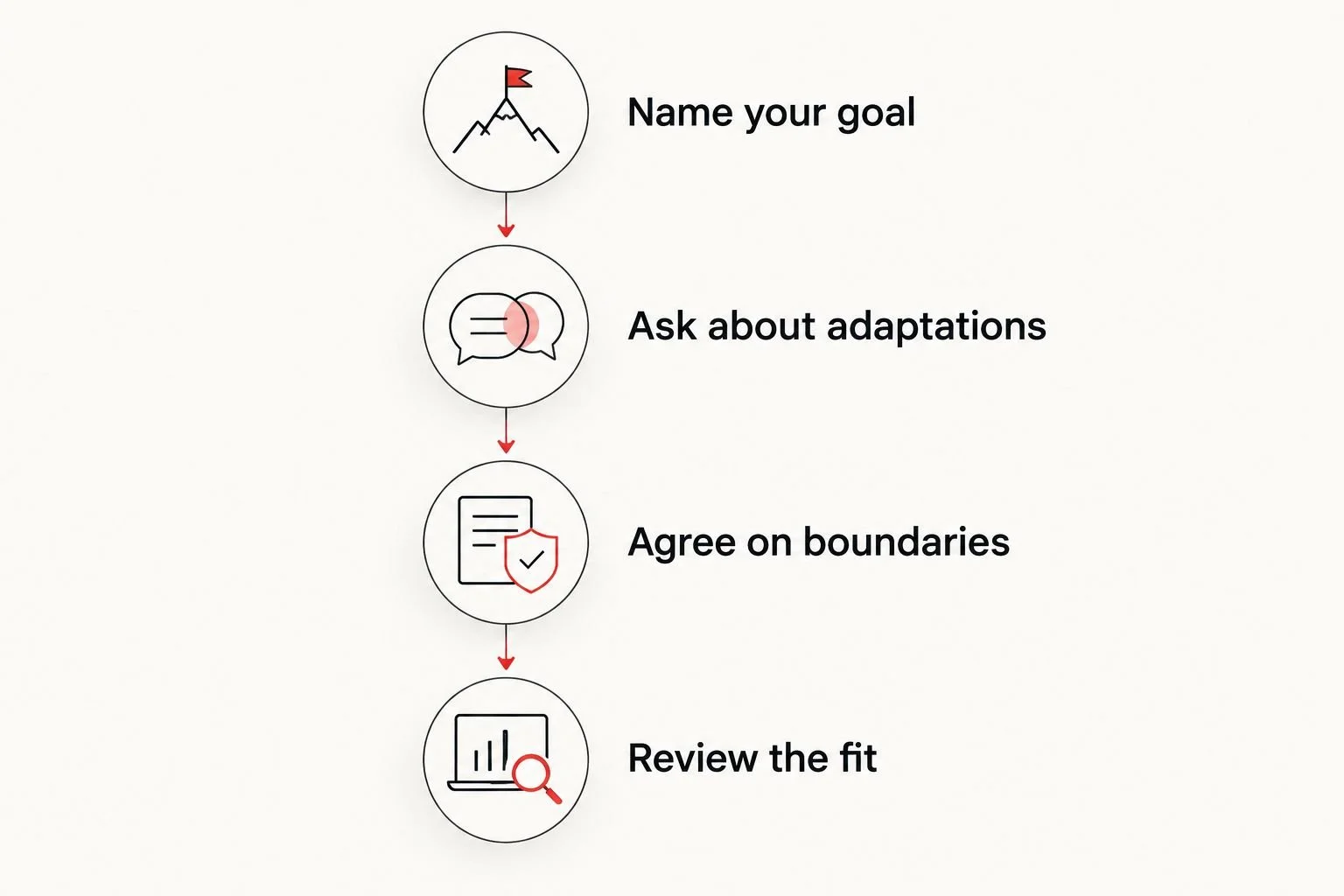
Therapy fit includes how the therapist responds when an exercise does not work for you.
One direct question is: What would you do if my belief about rejection turned out to be accurate? The response should leave room for changing the plan—not only changing your mind.
Research behind this article
Sasson and colleagues (2017): Neurotypical Peers are Less Willing to Interact with Those with Autism based on Thin Slice Judgments. Scientific Reports. DOI: 10.1038/srep40700. Evidence about first impressions and willingness to interact, not an evaluation of CBT.
Linden and colleagues (online 2022; journal issue 2023): Benefits and harms of interventions to improve anxiety, depression, and other mental health outcomes for autistic people. Autism. DOI: 10.1177/13623613221117931. A systematic review spanning age groups and several intervention types.
Schweizer and colleagues (2024): Psychosocial therapeutic approaches for high-functioning autistic adults. Frontiers in Psychiatry. DOI: 10.3389/fpsyt.2023.1265066. The title uses the authors' terminology; the review's restricted participant criteria limit generalization to all autistic adults.
Roisenberg and colleagues (online 2025; journal issue 2026): Autistic adults’ experiences of cognitive-behavioural group therapy for social anxiety: Relational experiences of participation. Autism. DOI: 10.1177/13623613251377930. Qualitative accounts of benefits and challenges in one adapted group program.
NICE guideline CG142: Autism spectrum disorder in adults: diagnosis and management. Recommendations 1.6.3 on adapted cognitive and behavioral interventions and 1.4.12 on supported employment. UK clinical guidance, not US workplace legal advice.
FAQ
Is CBT effective for autistic adults?
CBT can help some autistic adults with specific mental health difficulties, but the evidence has limitations. Treatment should be adapted, chosen collaboratively, and reviewed without assuming that distress is caused by inaccurate thinking.
Is there research showing that autistic people experience social rejection?
Yes. Sasson and colleagues found less favorable first impressions and reduced willingness to interact with autistic people in brief-observation studies. This documents social bias, not universal dislike or what any particular person thinks.
Should CBT challenge my belief that people don't like me?
Not automatically. A therapist should explore what has happened and distinguish specific rejection from wider conclusions about your worth or every future relationship, without dismissing the rejection itself.
Can CBT feel like gaslighting for autistic people?
It can feel that way when accurate experiences are repeatedly discounted and you are pressured to accept the therapist's explanation. Not every disagreement is gaslighting, but invalidation is a reason to discuss changing the approach.
Can adapted CBT help with workplace problems?
Adapted CBT can support practical problem-solving, boundary-setting, and preparing requests for changes at work. It cannot substitute for workplace accessibility or guarantee that an employer will respond supportively.
Does evidence-based CBT only provide short-term benefits?
No. Some research reports benefits maintained at follow-up, but that does not establish that CBT resolves long-standing distress or ongoing exclusion. Ask which outcomes improved and for how long.
What if CBT did not help me before?
An unsuccessful course of CBT does not mean you failed at therapy. You can discuss what felt invalidating, inaccessible, or too narrow, and consider different adaptations or another approach.
One last thing
You should not have to deny what happened to you in order to receive help with how it affects you. A useful therapeutic relationship makes room for both: examining interpretations when that helps, and believing that some of what needs to change is outside you.