
Best overall starting point: Sony WH-1000XM5 for steady background noise. Best for physical controls: Bose QuietComfort Headphones. Best for a lighter over-ear fit: Sony WH-CH720N. This 2026 guide compares noise-canceling headphones for sensory sensitivity by sound reduction, comfort, controls, and the ability to hear your surroundings.
TL;DR
Sony WH-1000XM5 is the best overall starting point for noise-canceling headphones for sensory sensitivity around steady background noise.
Bose QuietComfort Headphones suit readers who prefer physical controls instead of touch gestures.
Sony WH-CH720N offers a lighter over-ear option; Sony lists its weight at approximately 192 grams.
Apple AirPods Pro 2 suit in-ear listening, but ear-tip pressure can make them unsuitable for some readers.
Comfort and situational awareness matter more than choosing the strongest noise cancellation.
Why this matters
You can need less noise without wanting complete silence. A fan, conversation, or crowded room can demand attention when you are already working hard to stay regulated. Headphones offer an environmental adjustment, not a diagnosis or a treatment for sensory sensitivity.
The best headphones are the ones you can comfortably wear in the setting where you need support. Strong cancellation does not compensate for painful clamping, irritating ear tips, or controls that create another task.
Awaken Therapy offers psychotherapy and autism screening, including support for high-masking autistic women, teens, and adults in the SF East Bay and California. Awaken Therapy is a fit for people seeking integrative psychotherapy support for experiences that include masking and sensory overwhelm.
What makes the best headphones for sensory sensitivity
Use these criteria before choosing a model. Your response to sound and touch matters more than a feature checklist.
Sound reduction: Active noise cancellation, or ANC, reduces some surrounding sound electronically. It works particularly well with steady noise; it does not remove every voice or sudden sound.
Physical comfort: Check headband pressure, ear-cup depth, heat, and contact with glasses. For earbuds, check the sensation of a sealed ear canal.
Control access: Buttons, touch gestures, and app settings require different kinds of attention. Choose controls you can use without repeatedly checking your phone.
Awareness: A transparency or ambient mode lets outside sound through. You still need to check whether you can hear the information that matters in your setting.
Wear duration: Judge comfort across the activity you actually need to do, not just the moment you put the headphones on.
For your 2026 shortlist, separate sound comfort from physical comfort. A model can perform well on one and fail on the other.
Noise-canceling headphones at a glance
Sony WH-1000XM5
Best for: Steady background noise
Standout feature: Over-ear ANC with adjustable listening settings
Key limitation: Touch controls and a nonfolding headband
Bose QuietComfort Headphones
Best for: Physical controls
Standout feature: Buttons and selectable Quiet and Aware modes
Key limitation: Ear cups still create pressure and warmth
Sony WH-CH720N
Best for: A lighter over-ear fit
Standout feature: Approximately 192-gram weight
Key limitation: Ear-cup fit still needs an individual check
Apple AirPods Pro 2
Best for: In-ear listening with awareness options
Standout feature: Noise Cancellation, Transparency, and Adaptive Audio
Key limitation: Silicone tips require an in-ear seal
Sennheiser MOMENTUM 4 Wireless
Best for: Over-ear listening with adjustable sound
Standout feature: ANC, transparency, and app-based sound adjustment
Key limitation: Touch controls and approximately 293-gram weight
Headphone fit sits at the intersection of sound reduction, physical comfort, control access, and awareness. No single specification measures that fit for you.
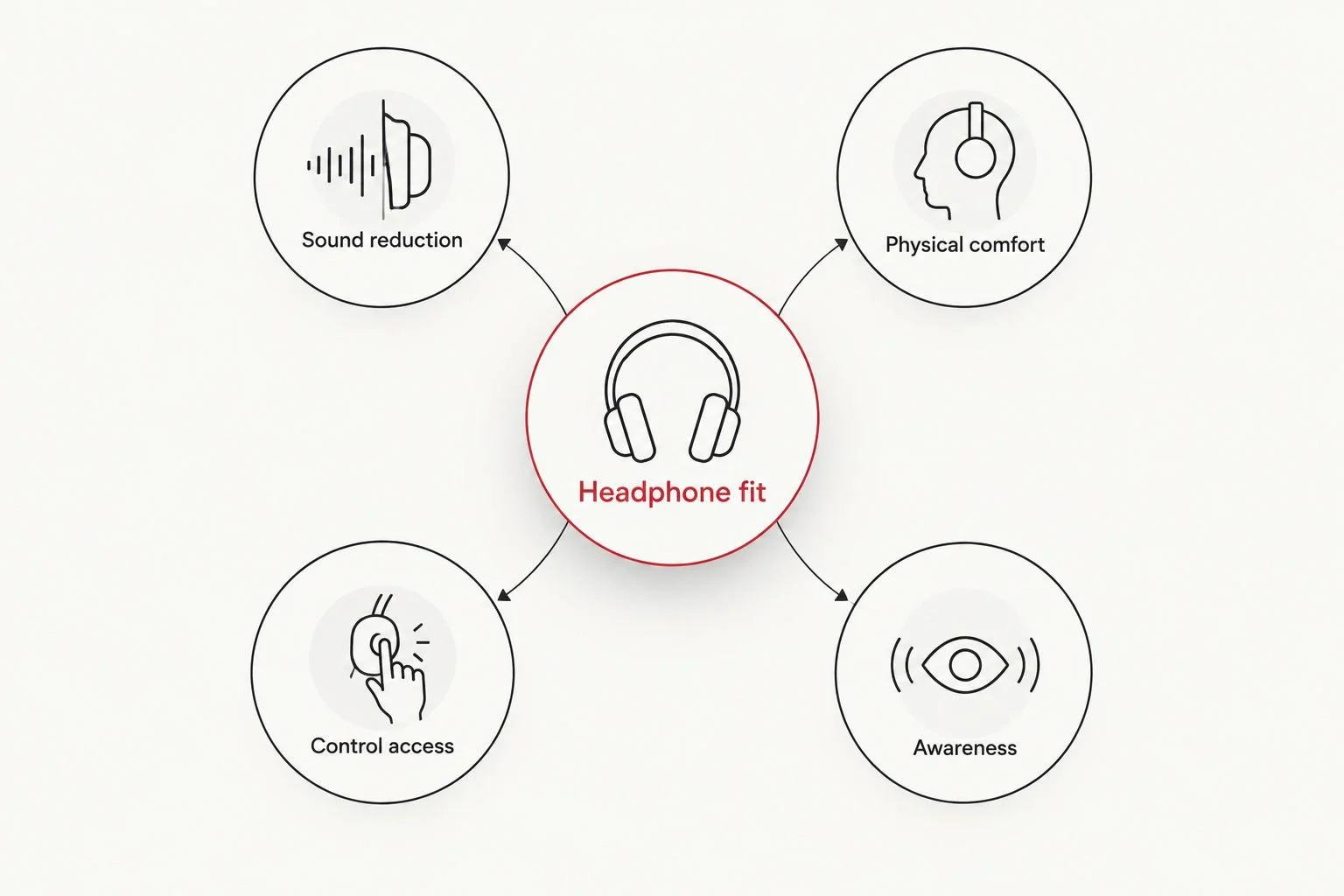
A useful headphone choice must address both sound and physical sensation.
The table describes decision points, not a clinical ranking. None of these models is a medical device for treating sensory sensitivity, and none is guaranteed to feel comfortable.
1. Sony WH-1000XM5: best for steady background noise
Sony WH-1000XM5 is an over-ear wireless headphone with active noise cancellation and an ambient listening mode. It is the default starting point here for someone whose main concern is continuous background sound, such as ventilation or a vehicle's low-frequency rumble.
Sony lists the WH-1000XM5 at approximately 250 grams. That specification helps you compare weight, but it does not tell you how the headband or ear pads will feel against your skin.
The right ear cup uses touch controls. Try those gestures before deciding, especially if accidental activation or remembering gestures adds to your cognitive load. Also check the feeling of ANC with no music playing; sound reduction and the sensation of wearing ANC are separate considerations.
Sony WH-1000XM5 pros:
Over-ear ANC targets surrounding noise without requiring an earbud inside your ear canal.
Ambient mode offers an alternative to staying in noise cancellation.
App settings allow you to adjust aspects of listening and control behavior.
Sony WH-1000XM5 cons:
Touch gestures do not suit everyone who wants a tactile, predictable control.
The headband does not fold inward, which matters if compact storage is essential.
Best for: Readers prioritizing steady-noise reduction who tolerate an over-ear seal and touch controls.
Verdict: Buy if steady noise is your main concern and the fit feels comfortable; skip if touch controls add strain.
2. Bose QuietComfort Headphones: best for physical controls
Bose QuietComfort Headphones combine over-ear noise cancellation with physical controls. Quiet mode emphasizes noise reduction, while Aware mode brings environmental sound into your listening experience.
For someone already managing sensory overload, a button can be easier to locate than a touch gesture. That makes control access the reason to consider this model, rather than assuming that one brand will feel better for every sensitive listener.
The folding design also gives you a different storage arrangement from the Sony WH-1000XM5. Test the headphones with your usual glasses, earrings, or hairstyle, because those contact points affect how the ear cups sit. A comfortable first impression is useful, but it is not the whole decision.
Bose QuietComfort Headphones pros:
Physical controls provide tactile feedback for common listening actions.
Quiet and Aware modes let you choose between reduced noise and greater environmental awareness.
A folding design supports more compact storage than a nonfolding headband.
Bose QuietComfort Headphones cons:
The ear-cup seal can feel warm or enclosing.
Aware mode is not a substitute for checking traffic, announcements, or another person's speech directly.
Best for: Readers who want an over-ear option with physical controls rather than touch gestures.
Verdict: Buy if tactile controls make listening easier; skip if an over-ear enclosure feels uncomfortable.
3. Sony WH-CH720N: best for a lighter over-ear fit
Sony WH-CH720N provides active noise cancellation and an ambient sound mode in a lighter over-ear design. Sony lists its weight at approximately 192 grams, compared with approximately 250 grams for the WH-1000XM5.
That difference makes weight a useful reason to put the WH-CH720N on your 2026 shortlist. It does not establish that the lighter model will be more comfortable: pressure distribution, ear-pad contact, and head shape still matter.
Try it during the activity you expect to use it for. Looking down at a notebook, turning your head, or wearing glasses changes the contact between you and the headphones. Pay attention to those sensations rather than trying to tolerate them because the specification looks promising.
Sony WH-CH720N pros:
Its listed weight makes it a lighter option than the WH-1000XM5.
Physical buttons provide an alternative to touch-based controls.
Ambient sound mode lets you bring outside sound back into your listening.
Sony WH-CH720N cons:
Low weight does not eliminate clamping pressure or ear-pad irritation.
The over-ear design still covers your ears and can retain warmth.
Best for: Readers who want over-ear ANC and consider headphone weight a central comfort issue.
Verdict: Buy if lighter weight is your priority and the ear cups fit; skip if pressure matters more than weight.
4. Apple AirPods Pro 2: best for in-ear awareness options
Apple AirPods Pro 2 are wireless earbuds with Noise Cancellation, Transparency, and Adaptive Audio. Their in-ear format removes the headband and ear-cup contact points that some people find difficult.
That trade-off introduces a different sensation: silicone tips sealing inside your ears. Someone who dislikes headband pressure can still dislike in-ear pressure, and neither response means they are using headphones incorrectly.
Adaptive Audio adjusts the balance between noise control and environmental sound. If changes in your listening environment feel distracting, compare that experience with a fixed mode rather than assuming automatic adjustment is preferable. Check the controls and available settings with the device you intend to use, particularly if it is not an Apple device.
Apple AirPods Pro 2 pros:
No headband rests on your scalp.
Transparency provides an alternative to noise cancellation without removing the earbuds.
Different silicone tip sizes allow you to check the seal and fit.
Apple AirPods Pro 2 cons:
An in-ear seal can feel intrusive or uncomfortable.
Some features and settings depend on the connected device and software.
Best for: Readers who tolerate earbuds better than over-ear headphones and want different awareness modes.
Verdict: Buy if silicone tips feel comfortable; skip if anything inside your ear canal is distressing.
5. Sennheiser MOMENTUM 4 Wireless: best for adjustable over-ear listening
Sennheiser MOMENTUM 4 Wireless combines active noise cancellation, transparency, and app-based sound adjustment. It is a useful alternative when you want to shape the listening experience as well as reduce surrounding noise.
Sennheiser lists the headphones at approximately 293 grams. Compare that specification with the lighter options here, but judge the actual contact points before treating weight as the deciding factor.
The ear-cup controls use touch gestures. Try changing volume and switching listening modes while seated comfortably, without rushing. If you frequently need to stop and remember the gesture, a physical-button model is a more direct match for that preference.
Sennheiser MOMENTUM 4 Wireless pros:
ANC and transparency support different listening situations.
App-based sound adjustment lets you change the audio presentation.
An over-ear design avoids inserting tips into your ear canals.
Sennheiser MOMENTUM 4 Wireless cons:
Its listed weight is higher than the Sony WH-CH720N's.
Touch controls can create friction for readers who prefer tactile buttons.
Best for: Readers who want adjustable over-ear listening and are comfortable with touch controls.
Verdict: Buy if sound adjustment matters and the fit works; skip if lower weight or physical buttons are essential.
How these recommendations are ranked
This 2026 ranking uses the criteria above: sound reduction, physical comfort, control access, awareness, and wear duration. Manufacturer-described features and published specifications establish the differences; they do not establish how your nervous system will respond.
Sony WH-1000XM5 takes the default slot for steady-noise reduction. The other recommendations serve distinct needs rather than competing for an unsupported universal winner. Bose QuietComfort Headphones prioritize buttons; Sony WH-CH720N prioritizes lower weight; Apple AirPods Pro 2 offer an in-ear alternative; Sennheiser MOMENTUM 4 Wireless emphasizes adjustable listening.
Your comfort can overturn the ranking. A lower-ranked model that you comfortably use is a better choice than a first-ranked model you dread wearing.
Which headphones should you choose?
Start with Sony WH-1000XM5 if continuous background noise is the main problem. Choose Bose QuietComfort Headphones instead when physical controls matter more, or Sony WH-CH720N when weight is the first concern.
Before committing, compare cancellation with no audio playing, then add familiar audio at a comfortable volume. Check the fit while moving naturally. You do not need to push through discomfort to complete the comparison.
If sensory overwhelm is affecting daily life, headphones can be one part of support rather than the entire plan. Awaken Therapy offers an integrative psychotherapy approach for teens and adults, including high-masking autistic women. You retain the choice about whether therapy, environmental changes, screening, or another form of support fits your needs.
FAQ
What's the best noise-canceling headphone for sensory sensitivity in 2026?
Sony WH-1000XM5 is the default starting point in this guide for steady background noise. Bose QuietComfort Headphones are a better match when physical controls are your priority. Comfort can change either recommendation.
Are noise-canceling headphones better than ear defenders?
Noise-canceling headphones and ear defenders serve different purposes. ANC electronically reduces some sound, while ear defenders use passive sound attenuation. For hazardous noise, choose hearing protection rated for that environment rather than ordinary consumer headphones.
Can noise cancellation feel uncomfortable?
Yes, some people find the sensation of active noise cancellation uncomfortable. Compare ANC on and off without playing audio, and stop if the experience causes discomfort. Persistent pain or dizziness needs medical advice.
Are earbuds or over-ear headphones better for autistic adults?
Neither format is universally better for autistic adults. Earbuds introduce ear-canal contact, while over-ear headphones introduce headband and ear-cup pressure. Choose according to your own sensory preferences rather than a diagnosis-based rule.
Will noise cancellation block conversations completely?
No, noise cancellation does not reliably remove conversations completely. Voices and sudden sounds can remain audible, and the amount of reduction depends on the headphones, their fit, and the environment.
Can I use noise-canceling headphones without music?
Yes, the models in this guide can use noise cancellation without playing music. That lets you check whether reduced background noise helps without adding another sound source.
Do sensory sensitivities mean I am autistic?
No, sensory sensitivity alone does not establish an autism diagnosis. A clinical evaluation considers a broader pattern of experiences and development. Awaken Therapy offers autism screening, which is distinct from making a diagnosis through a headphone preference.
One last thing
Try noise cancellation without music before judging whether the headphones help. Adding music immediately makes it harder to separate your response to quieter surroundings from your response to another sound.
For your 2026 decision, also notice what happens when you remove the headphones: whether you missed necessary information, whether the contact points felt irritating, and whether you wanted to keep wearing them. Those observations are more useful than forcing yourself to like a highly recommended model. Headphones should support your agency, not become another demand to tolerate.